Sometimes, we do not simply lose two people in close succession. We lose two different chapters of our own lives.
One leaves us remembering our younger selves at the beginning of the journey. The other, a friendship we found years later…
Cedric Gillott was the mentor who opened the door to my doctoral journey. Laura Palanker Musselman was a friend who became part of the past ten years of my career—someone I found late, but walked closely beside.
Now I am saying goodbye to them both.
Cedric: A Door That Opened in the Snow
November 2005.
Saskatoon.
It was bitterly cold. A thin layer of snow covered the ground. I stepped timidly into the W. P. Thompson Biology Building at the University of Saskatchewan. A foreign country, unfamiliar corridors, and a long doctoral journey ahead whose course I could not yet imagine…
In the corridor, I found the door bearing the name Cedric Gillott.
I knocked.
When that door opened, I did not simply meet my doctoral co-supervisor. I met a warm, fatherly man who, from the very first moment, made me feel that I was no longer a stranger.
He took me out for a meal. He showed me around the campus and the building.
“Today, lunch is on me,” he said.
At that first meal, we talked about science. We talked about life. And we talked about football…
I later learned that football was not merely a conversation topic or a weekend pastime for him. Cedric was also an important figure in Saskatchewan’s football history. He had played, captained a team, coached the University of Saskatchewan Huskies men’s soccer team, and nurtured young players. Years later, in 2011, he would be inducted into the Saskatoon Sports Hall of Fame.
So our conversation about football on that first day was no coincidence. I had come to know him through one of his two great passions—science. He had welcomed me through the other—football.
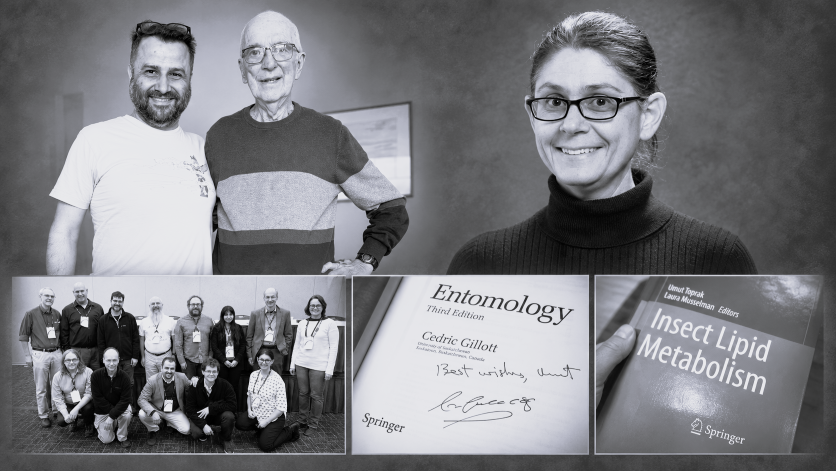
Cedric’s story had begun in Sheffield. He studied zoology at the University of Nottingham and, after completing his doctorate in 1965, joined the Department of Biology at the University of Saskatchewan that same year. He published more than a hundred scientific works. His book, Entomology, first published in 1980, with its third edition appearing in 2005—the year I met him—introduced generations of students, thousands of them, to the world of insects.
On the opening page of the copy he signed for me, these words remain:
“Best wishes, Umut.”
Sometimes, just a few words take on an entirely different weight years later.
Cedric was one of the students trained by Sir Vincent B. Wigglesworth, regarded as a founding figure in entomology and insect physiology. I always saw Cedric as one of the living bearers of the entomological tradition Wigglesworth had established. Before me stood not only a distinguished entomologist, but also a mentor who had directly inherited the knowledge and ethos of a scientist who changed the history of insect physiology.
And I became Cedric’s last doctoral student.
Science, too, has a lineage. One carried forward not through blood, but through knowledge, work, and conduct… How you approach a question, how you share what you know, how you welcome a young scientist at your door—these things pass from one generation to the next.
From Wigglesworth to Cedric…
From Cedric to me…
From me to my students…
An invisible yet unbroken chain of science stretching back almost a century.
Some of the values I try to pass on to my students today were values Cedric learned from Wigglesworth. I learned them from Cedric. Perhaps one day my students will pass them on to their own students.
To me, this is the true academic legacy. Not only published work, but a way of thinking, scientific integrity, and humanity passed from one scientist to another…
I have always been honoured to have been Cedric Gillott’s student. Not everything I learned from him was written in books. Some things he never even explained. I watched how he treated people, and I learned. He showed me that knowing so much does not require making others feel small.
Beyond his scientific work, he had lived a wonderfully full life. Football, gardening, bees, birds, Labradors, swimming… He and his wife, Anne, had built a life together over fifty-seven years in their Grasswood home. He was a scientist, a teacher, a coach, a husband, a father, and a grandfather.
I saw Cedric for the last time in May 2026.
I did not know it would be our last meeting.
How can anyone know which meeting will be the last?
He did not look well. I felt an uneasiness I could not name. Before leaving, I wanted to record a short video. Perhaps I had sensed something. Or perhaps I simply wanted to take his voice and his movements with me.
I will keep that video to myself.
But I want you to see the photograph we took that day. Because sometimes, twenty-one years of a mentor and his student’s shared story can fit into a single frame. You see two people standing side by side. Yet within that photograph are a first encounter, a lunch, long conversations, science, football, and the enduring gratitude of all those years.
Cedric passed away on 12 September 2026, aged eighty-six. He left behind Anne, his partner in life for sixty-two years; their children, Stewart, Carol, and Neil; his grandchildren; his students; and the countless people whose lives he touched.
The mentor whose hand I felt on my shoulder at the beginning of my journey is gone. I will not be able to thank him face to face once more. But by keeping what he taught me alive, and by telling his story, perhaps I can repay a little of what I owe him.
Laura: A Friendship That Began Late and Ended Too Soon
My friendship with Laura began late.
The goodbye came far too soon.
This friendship, which became part of the past ten years of my career, grew stronger through the symposium we organised together in St. Louis in 2019: “From Fat to Fact: Recent Insights on Insect Lipid Metabolism.” We brought fourteen scientists from different countries together under one roof. We shaped an idea. We believed in it. We helped it grow together.
The symposium did not remain a single meeting. In June 2021, we jointly served as guest editors of the special issue bearing the same title in Volume 133 of Insect Biochemistry and Molecular Biology, one of the heavyweight journals in the field. We wrote an editorial together. Who would have thought even an editorial could attract so many citations! But it did. There was feeling between the lines.
Then the pandemic began.
As the world closed its doors, we were opening the pages of a new book.
One day, I said to Laura:
“Let’s put this book together.”
She did not hesitate.
“Let’s do it,” she said.
What followed were hundreds of Zoom meetings, conversations stretching past midnight, thousands of emails, invitations to contribute chapters, revisions, further revisions, and page after page of shared work. It would be no exaggeration to say we gave years of our lives to it: putting that book together took almost four years.
A book is not made simply by bringing chapters together. The trust two people place in one another, their patience, their willingness to spend years pursuing the same idea—these, too, make up its unwritten pages.
Laura and I wrote those unwritten pages together.
Eventually, my copy of Insect Lipid Metabolism, published by Springer, arrived. Our names stood side by side on the cover:
Umut Toprak
Laura Musselman
Editors
I was so happy at that moment. But sometimes we only understand the true meaning of a moment much later. I did not know that one day, that cover would represent not only our shared scientific achievement, but also the most tangible reminder of my friendship with Laura.
When she told me she had been diagnosed with that relentless illness, I said:
“You’ll get through this.”
I truly wanted to believe it. I wanted her to believe it, too. For a while, everything seemed to be getting better. Then the illness progressed. The treatments did not bring the response we had hoped for.
In our last conversation, she told me:
“I have no hope left, Umut. I am living the last days of my life.”
“No,” I said. “That’s not how it will be.”
I said it not because I knew, but because I needed to believe it.
Never in my life had I wanted words to prove untrue so desperately.
I wanted so badly to be wrong.
I was wrong.
I came across official confirmation of Laura’s death in a line of just a few words in the Binghamton University Faculty Senate agenda dated 16 September 2026:
“Prof. Laura Palanker Musselman, Biological Sciences.”
Sometimes, a person’s life fits into a single line in an official document.
Yet behind that line was a life of fifty years. We lost her far too young. But how much she had fitted into those years. Students, research, ideas, papers, conversations in the middle of the night… Then there were the worries and laughter we shared during the pandemic, and our book, which took years of work to complete…
Our friendship began late and lasted only a short time. Yet it left behind a symposium, a special issue, joint publications, thousands of messages, and an entire book.
From now on, whenever I pick up Insect Lipid Metabolism, I will see more than the lipid metabolism of insects. I will also remember Laura’s voice, her work, her patience, and our midnight conversations.
Some people do not fall silent when they leave.
They speak again on every page they have written.
What Remains
Cedric and Laura touched two different chapters of my life.
One opened the door at the beginning of the journey.
The other joined me further along the way.
One showed me how science is passed from generation to generation.
The other, how a shared idea can become a lasting work through dedication…
One treated me to a meal when we first met.
The other said “Let’s do it” without hesitation when I suggested we put a book together.
These may seem like small things.
They are not.
Because today, the world is full of the noise of ruthless people. They shout louder, make themselves more visible, and imagine themselves to be more powerful.
But they are not the ones who keep the world turning.
The world keeps turning because of those who welcome a timid student at their door.
Because of those who do not keep their knowledge to themselves.
Because of those who give a young person confidence.
Because of those who shoulder a friend’s burden as though it were their own.
Because of those who do good without turning their kindness into a performance.
It is still good people who keep the world turning.
Perhaps that is why saying goodbye to good people is so difficult. When they leave, we lose more than a person. We lose one of the reasons we hold on to the belief that the world can still be a good place.
One day, we will all leave.
Our titles will fall away before we do.
The distinctions before our names will fade.
The nameplates on our office doors will change.
What will remain is the work we have created.
And the kindness we have shown to others…
Our work preserves our names. Our kindness becomes part of other people’s lives.
One lives on in libraries.
The other, in people’s hearts.
Perhaps that is true immortality.
Cedric…
Laura…
You wrote your names into science.
And you left your kindness with us.
I am so grateful to have known you.
So grateful that our paths crossed.
May heaven be your resting place.
I will miss you both.
Umut Toprak