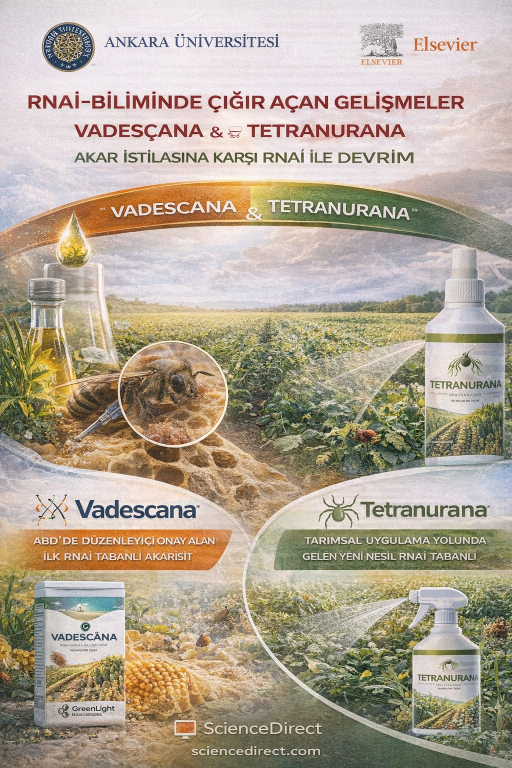
A comprehensive review article authored by an international research consortium and co-corresponded by Prof. Dr. Umut Toprak (Ankara University, MOLEN Lab.) has been published online in the Elsevier journal Insect Biochemistry and Molecular Biology. The article can be accessed at:
https://www.sciencedirect.com/science/article/pii/S0965174826000445
Titled “RNAi-based Acaricides: On the Path to Commercialization of New Tools for Mite Management in Crops and Hives,” the review provides an in-depth scientific assessment of RNA interference (RNAi) as a next-generation approach for controlling agriculturally significant mite pests and parasitic mites affecting honey bees.
The article synthesizes advances in mite genomics, RNAi mechanisms, target gene identification, dsRNA delivery technologies, and environmental safety, charting how these developments have enabled RNAi-based acaricides to move from experimental systems toward practical solutions compatible with integrated pest management and resistance management strategies.
With Prof. Dr. Umut Toprak serving as corresponding author, the publication highlights Ankara University’s strong international engagement in molecular pest control research and underscores the growing translational impact of RNAi technologies in sustainable agriculture.
From Regulatory Breakthrough to a Growing RNAi Acaricide Pipeline
The review also discusses a critical milestone in the field: vadescana, an RNAi-based acaricide developed by GreenLight Biosciences, has received regulatory approval in the United States and entered commercial use for the control of Varroa destructor, the most damaging parasite of honey bee colonies. This approval represents the first regulatory authorization of an RNAi-based acaricide, demonstrating that RNAi technologies can meet efficacy and regulatory standards.
Building on this achievement, the article outlines the ongoing advancement of “Tetranurana”, an RNAi-based acaricide targeting agriculturally important spider mites. Tetranurana is progressing along the regulatory and commercialization pathway, illustrating the emergence of a structured RNAi acaricide pipeline that addresses key mite pest complexes in both crops and hives.
Together, these developments signal a transition of RNAi-based acaricides from isolated innovations to a coherent and emerging class of pest management tools, offering novel modes of action, high species specificity, rapid environmental degradation, and strong alignment with sustainable agriculture goals.